Free Recruiting Software: Benefits, Limitations & Best Practices
Free recruiting software has become an increasingly popular option for small businesses, startups, and organizations with limited hiring budgets. Understanding the capabilities and constraints of these tools helps recruiters make informed decisions about when free solutions are appropriate and when investing in paid platforms becomes necessary.
Understanding Free Recruiting Software
Free recruiting software refers to applicant tracking and recruitment management platforms that organizations can use without monetary payment. These solutions typically offer core hiring functionalities such as job posting, candidate tracking, and basic communication tools. The availability of free recruiting software has democratized access to recruitment technology, allowing even the smallest organizations to benefit from structured hiring processes.
Most free recruiting platforms operate on freemium business models, where basic features remain free while advanced capabilities require paid subscriptions. This approach allows providers to offer genuine value to small-scale users while generating revenue from organizations that outgrow the free tier. Understanding this business model helps recruiters set realistic expectations about what free tools can and cannot deliver.
The evolution of free recruiting software mirrors broader trends in software-as-a-service (SaaS) business models. As cloud infrastructure costs have decreased and competition has intensified, providers have been able to offer more robust free tiers. This has raised the baseline functionality available without payment, making free recruiting software a viable option for more use cases than ever before.
Core Features of Free Recruiting Solutions
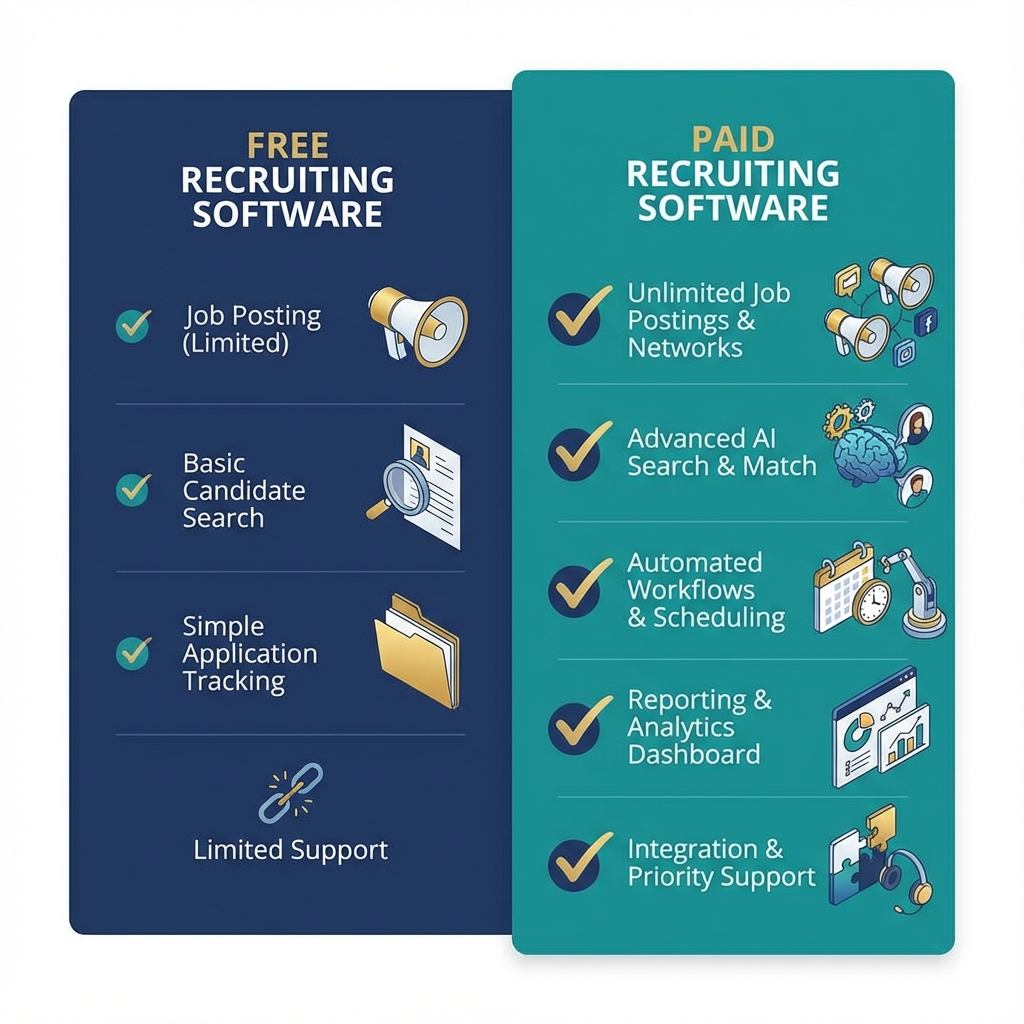
Free recruiting software typically includes fundamental applicant tracking capabilities. Users can post job openings to the platform itself and often to a limited number of external job boards. Candidate profiles can be created and stored in a centralized database, allowing recruiters to track where each applicant stands in the hiring pipeline.
Communication features in free platforms usually support basic email integration and templated messaging. Recruiters can send standardized responses to applicants and schedule interviews using calendar integrations. While these features lack the sophistication of paid platforms, they provide sufficient functionality for straightforward hiring processes with moderate candidate volumes.
Collaboration tools in free software allow multiple team members to access candidate information and leave notes or ratings. This facilitates team-based hiring decisions without requiring complex workflow automation. However, permission settings and role-based access controls are often simplified compared to enterprise solutions.
Reporting and analytics in free recruiting platforms tend to focus on basic metrics such as time-to-fill, source effectiveness, and pipeline status. These insights help small teams understand their recruiting performance without the advanced analytics and customizable dashboards found in premium tools.
When Free Recruiting Software Makes Sense
Free recruiting software is particularly well-suited for small businesses hiring fewer than 10-15 employees per year. At this volume, the limitations of free platforms rarely become constraints, and the cost savings are meaningful. Startups in their early stages often find that free tools provide everything they need to build their initial teams.
Organizations with straightforward hiring processes benefit from free recruiting software. When recruitment follows predictable patterns without complex approval workflows or specialized screening requirements, the simplicity of free tools becomes an advantage rather than a limitation. Simple hiring processes don't require sophisticated automation or customization.
Seasonal hiring operations can leverage free recruiting software effectively. Organizations that hire intensively during specific periods but maintain minimal recruiting activity otherwise may find that free tools meet their periodic needs without the ongoing cost of paid subscriptions. The ability to scale up and down without financial commitment offers flexibility.
Non-profit organizations and educational institutions with constrained budgets often rely on free recruiting software. These organizations prioritize mission-critical spending and may have difficulty justifying recruitment software expenses. Free platforms allow them to implement structured hiring processes without budget approval challenges.
Limitations and Constraints
User limits represent one of the most common constraints in free recruiting software. Many platforms restrict the number of active users who can access the system, which can be problematic for distributed hiring teams or organizations where many stakeholders participate in recruitment decisions. This limitation may force organizations to choose between involving the right people and staying within free tier restrictions.
Job posting limits affect how many open positions can be listed simultaneously. Some free platforms allow only one or two active job postings at a time, making them unsuitable for organizations with ongoing hiring across multiple roles. Understanding these limits before committing to a platform prevents disruption when hiring needs expand.
Candidate storage restrictions limit how many applicant profiles can be maintained in the system. Some free platforms delete older applications after a certain period or cap the total number of stored profiles. This can be problematic for organizations building talent pools for future opportunities or those subject to recordkeeping requirements.
Integration capabilities are typically limited in free recruiting software. While basic email and calendar integrations usually work, connections to HR information systems, background check providers, and assessment platforms often require paid subscriptions. Organizations with complex technology ecosystems may find free tools insufficiently connected to their broader systems.
Customization options in free platforms tend to be minimal. Organizations must adapt their processes to fit the software rather than configuring the software to match their workflows. This works well for standardized hiring but becomes limiting when unique organizational requirements emerge.
Maximizing Value from Free Solutions
Standardizing hiring processes allows organizations to work effectively within the constraints of free recruiting software. By developing consistent approaches to candidate screening, interview scheduling, and decision-making, recruiters can leverage the automation and structure that free tools provide without needing advanced customization.
Clear communication with hiring teams about platform limitations prevents frustration and workarounds. When stakeholders understand why certain features are unavailable, they can adjust expectations and find alternative solutions for capabilities that fall outside the free tier. Transparency about constraints helps teams work within them effectively.
Regular data hygiene practices become more important when using free recruiting software with storage limitations. Archiving old applications, removing duplicate entries, and purging unnecessary candidate profiles helps organizations stay within storage caps while maintaining system performance. Disciplined data management extends the viability of free platforms.
Supplementing free recruiting software with other free tools can fill capability gaps. Organizations might use free project management software for complex hiring workflows, free communication platforms for team coordination, and free scheduling tools for interview management. This multi-tool approach requires more coordination but can deliver comprehensive functionality without cost.
Transitioning to Paid Solutions
Growth in hiring volume often triggers the need to transition from free to paid recruiting software. When the number of hires per year exceeds 15-20, the efficiency gains from advanced features typically justify subscription costs. Organizations experiencing rapid growth should anticipate this transition and plan accordingly.
Process complexity represents another transition trigger. As hiring workflows become more sophisticated with multiple approval stages, specialized screening requirements, and detailed compliance tracking, the limitations of free platforms begin to impede efficiency. Paid solutions offer the workflow automation and customization needed for complex processes.
Compliance requirements may necessitate paid recruiting software. Organizations subject to federal contractor obligations, industry-specific recordkeeping requirements, or international data protection regulations often need capabilities beyond what free platforms provide. Compliance risk can justify investment in more robust solutions.
Some modern recruiting platforms offer both free and paid tiers, allowing organizations to start without cost and upgrade as needs grow. For example, Flowxtra's free recruiting software provides unlimited free job posting capabilities alongside its applicant tracking and talent management features, enabling organizations to begin with basic recruiting functionality and scale their technology investment as hiring volume increases. This freemium model makes professional-grade recruiting tools accessible to startups and small businesses that might otherwise rely on manual processes or expensive enterprise solutions.
Integration needs drive transitions when organizations implement HR information systems, performance management platforms, or other enterprise software that requires deep connectivity with recruiting tools. Paid platforms typically offer the APIs and pre-built integrations necessary for cohesive technology ecosystems.
Best Practices for Implementation
Evaluating multiple free recruiting platforms before committing helps organizations find the best fit for their specific needs. Different providers impose different limitations, and features vary across platforms. Conducting thorough trials with real hiring processes reveals which platform aligns best with organizational requirements.
Training hiring team members on the selected platform ensures consistent usage and maximizes the value of available features. Even simple recruiting software requires some learning, and proper training prevents inefficient workarounds or underutilization of capabilities. Investing time in training pays dividends in improved efficiency.
Establishing clear processes for common recruiting activities creates consistency and helps teams work effectively within platform constraints. Documented procedures for job posting, candidate screening, interview scheduling, and offer management ensure that everyone follows the same approach, reducing confusion and improving the candidate experience.
Monitoring key recruiting metrics helps organizations understand whether their free recruiting software continues to meet their needs or whether limitations are creating inefficiencies. Tracking time-to-fill, cost-per-hire, and candidate satisfaction provides objective data for evaluating when a transition to paid software becomes justified.